



When it comes to the cost of a metal 3D printer, the price of the machine itself cannot be the only consideration. The technology used, type of metal, build volume, auxiliary equipment, software, skilled personnel, production time, and post-processing operations all play a role in the final cost.
Therefore, to estimate the actual cost, two issues should be considered separately: the purchase price of the machine and the cost of manufacturing a part with a metal 3D printer.
What Factors Does the Cost of a Metal 3D Printer Depend On?
The cost of a metal 3D printer depends on factors such as build chamber size, laser or energy source power, number of nozzles or lasers, level of automation, and compatible materials.
In the global market, examples of metal machines and systems have been reported at approximately the following prices:
Prusa i3 MK3S+ with related equipment | Metal FDM | $1,500 |
|---|---|---|
| UltiMaker Method | Metal FDM | $4,500 |
| BCN3D Epsilon Series | Metal FDM | $9,100 |
| Raise3D MetalFuse Forge1 | Metal FDM | $12,000 |
| One Click Metal MPrint+ | LPBF | $99,000 |
| Markforged Metal X | Metal FDM | $99,500 |
| Xact Metal XM200G | LPBF | $100,000 |
| 3D Systems DMP Flex 100 | LPBF | $180,000 |
| Trumpf TruPrint 1000 | LPBF | $190,000 |
| Desktop Metal InnoventX | Binder Jetting | $250,000 |
| HP Metal Jet S100 | Binder Jetting | $399,000 |
| Nikon SLM 125 | LPBF | $400,000 |
| Some advanced industrial systems | LPBF / DED / Other technologies | $500,000+ |
These figures are approximate and do not necessarily include installation, shipping, training, auxiliary equipment, taxes, customs, software, and support costs.
1. The Actual Cost Is Not Just the Machine
One of the common mistakes when evaluating the cost of a 3D printer is considering the listed machine price to be the same as the final investment.
For industrial use, additional equipment such as a furnace, powder management system, support removal equipment, heat treatment equipment, inert gas systems, specialized software, and quality control tools may be required.
2. How Is the Cost of Manufacturing a Part with a Metal 3D Printer Calculated?
The cost of manufacturing a metal part with a 3D printer usually consists of several main costs:
- Raw material cost
- Machine usage time
- File preparation and engineering services
- Energy and gas consumption
- Machine depreciation
- Supports and consumables
- Post-processing operations
- Quality control
- Number of parts produced
Specialized sources also identify technology, order quantity, raw material, geometric complexity, and post-processing as the main factors determining part cost.
3. Does the Type of Metal Affect the Cost of 3D Printing?
Material selection is one of the most important factors in the cost of a 3D printer and the cost of manufacturing a part.
Metal powders used in industrial processes are more expensive than many commonly used materials.
Material | Approximate Material Price per Kilogram |
|---|---|
316L Stainless Steel | $88/kg |
AlSi7 Aluminium | $94/kg |
AlSi10Mg Aluminium | $98/kg |
Maraging Steel | $133/kg |
Inconel 718 | $145/kg |
Inconel 625 | $145/kg |
Ti-6Al-4V Titanium | $363/kg |
Pure Grade 2 Titanium | $363/kg |
These figures are based on reference data from 2021, and actual prices today may vary depending on the manufacturer, purity, particle size, material standards, and market conditions.
In general, titanium alloys and nickel-based alloys such as Inconel tend to have higher costs. By reading the article Types of Metals That Can Be Produced with a 3D Printer, you can learn more about the types of metals suitable for metal 3D printers.
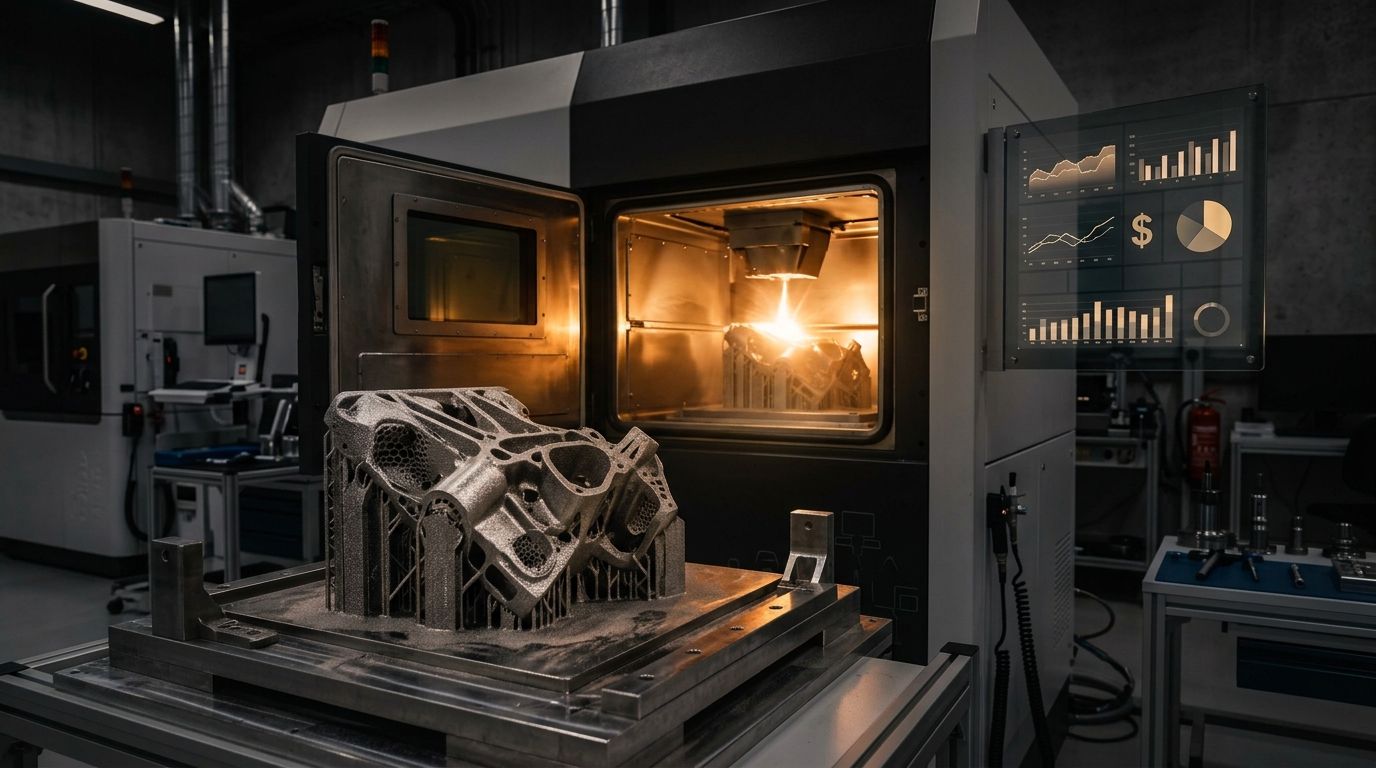
4. Part Complexity Changes the Cost of a Metal 3D Printer
Part geometry has a direct impact on the cost of a 3D printer and production time.
Parts with internal channels, lattice structures, thin walls, complex angles, or inaccessible surfaces may require more printing time and additional supports.
If you are still uncertain about selecting a suitable part for this technology, reviewing Parts Suitable for Metal 3D Printers for production can be useful for the initial evaluation of the part's geometry and application.
5. Printing Technology Determines the Cost of a Metal 3D Printer
Not all metal 3D printing methods have the same cost structure.
In LPBF, metal powder is placed layer by layer on the build bed, and a laser melts specific areas of the powder. This process provides high precision but requires specialized equipment, powder management, and precise process control.
In contrast, DED directly feeds material in the form of wire or powder into the build area and melts it using an energy source. This technology has important applications in manufacturing large parts, repairing and rebuilding components, and adding material to existing parts.
What Is the Difference Between DED and LPBF?
Choosing between DED and LPBF is not only a technical decision; it can also directly affect production costs.
DED is generally suitable for larger parts, repairs, and rapid material deposition, while LPBF is widely used for producing complex parts with high levels of detail and suitable precision.
A comparison of these two technologies in terms of build rate, accuracy, material type, part size, and applications is provided in the article Examining the Difference Between DED and LPBF Technologies in metal 3D printers.
6. Printing Time Increases the Cost of a Metal 3D Printer
The longer it takes to build a part, the greater the share of machine usage cost or Machine Time in the final price.
Part height, number of layers, build speed, material type, and process parameters affect printing time.
A part that comes out of the machine is not always the final, ready-to-use product. Depending on the technology and application, it may require operations such as the following:
- Support removal
- Heat treatment
- Machining
- Surface finishing
- Shot peening or other Finishing methods
- Dimensional inspection
- Quality control
This stage can account for a significant portion of the cost of a 3D printer for an industrial part.
7. The Impact of Part Quantity on Cost
Order quantity is also one of the important factors affecting the cost of a metal 3D printer.
If a complex part is produced only once, the cost of file preparation, process setup, and machine preparation is allocated to that single part.
However, when several identical parts are produced in a single Build, the fixed costs are distributed among a larger number of parts, which can reduce the final cost per part.
How Much Does It Cost to Manufacture a Part?
It is not possible to provide a fixed price for all metal parts. However, some industrial printing service sources have reported ranges of approximately $1,500 to $15,000 or more per part for large and complex LPBF parts.
Other sources also indicate that prices for metal printing services can vary from approximately $50 to $500 or more, depending on the material, dimensions, and complexity.
Metal type | Low to very high |
|---|---|
Part weight | Moderate to high |
Part volume | High |
Geometric complexity | High |
Printing time | High |
Amount of support | Moderate to high |
Post-processing | Moderate to very high |
Number of parts | Can reduce the unit price |
DED or LPBF technology | High |
Tolerance and quality control | Moderate to high |
Is Buying a Machine Better or Using Printing Services?
For many companies, purchasing a machine only becomes economically justified when its use is continuous and the production volume is significant.
Therefore, for a limited project, using part manufacturing services can be more economical than purchasing a machine. However, for continuous production, multiple prototypes, or the need for complete process control, purchasing equipment may be justifiable.
Ways to Reduce Production Costs with 3D Printing
To control the cost and price of manufacturing a part, it is better to manage costs from the design stage.
Some effective measures include:
- Selecting the technology according to the application
- Reducing unnecessary part volume
- Optimizing part orientation
- Reducing supports
- Using lattice structures where appropriate
- Selecting a material appropriate to the mechanical requirements
- Placing multiple parts in a single Build when possible
In fact, reducing the price does not happen only by choosing a cheaper machine; appropriate design can reduce printing time, material consumption, and post-production operations from the beginning.
What Services Does Vandad Sanat Provide in the Field of 3D Printing?
Vandad Sanat is a knowledge-based company active in advanced manufacturing technologies, focusing on the design and production of metal 3D printers and the manufacturing of complex industrial parts.
Therefore, for organizations that intend to evaluate the economics of printing a part, select a technology, or assess the feasibility of manufacturing a metal part, receiving technical consultation can be useful before deciding whether to purchase a machine or order a part.
Vandad Sanat Knowledge-Based Company, as one of the active companies in this field, is ready to cooperate with you. If needed, you can contact the company or complete the contact form.
Conclusion
Ultimately, the cost of a 3D printer is not a fixed number and should be evaluated based on the entire production chain.
Machine price, manufacturing technology, raw material, printing time, geometric complexity, amount of support, post-processing, and number of parts are among the most important factors affecting the price.
Frequently Asked Questions
How much does a metal 3D printer cost?
Depending on the technology, the price of metal 3D printers in the international market can range from approximately $1,500 for some simpler solutions to more than $1 million for advanced industrial systems.
How much does it cost to manufacture a metal part?
The cost of manufacturing a part depends on factors such as weight, material, dimensions, complexity, printing time, and post-processing. For complex industrial parts, the price can range from hundreds of dollars to several thousand dollars and, for large projects, even more.
Is LPBF more expensive than DED?
Not necessarily. The final cost depends on the type of part, material, build volume, production time, and post-processing operations.
What is the cheapest metal for 3D printing?
In many applications, stainless steel can be a more economical option than titanium and nickel-based alloys.
نظرات
0 نظر
دیدگاهی ثبت نشده.