



Wire metal 3D printer is one of the metal additive manufacturing methods in which the feedstock is introduced into the process in the form of metal wire.
In this technology, the wire is delivered in a controlled manner to the build area or the surface of the part and melted using an energy source. The molten material is then deposited layer by layer onto the surface to create the desired geometry.
This technology is known as Wire DED and can be used to manufacture metal parts, create sections of a part, and, in some projects, repair and restore components.
The main difference between this method and many other additive manufacturing processes is how the feedstock is supplied; in Wire DED, the metal wire is directly fed into the area where material needs to be added.
But how exactly does a wire metal 3D printer work? What types of wire are used in it, and what parts and industries can this technology be used for? To answer these questions, we first need to understand the structure and operation of Wire DED.
What Is a Wire Metal 3D Printer?
Directed Energy Deposition, more commonly known as DED technology, is one of the metal additive manufacturing technologies in which feedstock is added to a specific area of the part while energy is simultaneously applied.
In this process, the material can enter the build area in the form of wire or powder and can be melted and deposited using an energy source such as a laser, electric arc, or electron beam.
Wire DED is one branch of DED in which the feedstock, instead of powder, is introduced into the process in the form of metal wire. The wire is delivered in a controlled manner to the deposition area by a feeding system, while the energy source melts it.
The molten material is then deposited onto the surface of the part or the previous layer and, after cooling, bonds to it.
How Does Wire DED Technology Work?
To understand how this technology works, suppose you want to manufacture a large metal part based on a three-dimensional model.
First, the geometry of the part is prepared in software, and the movement path of the deposition system is defined. The machine then delivers the metal wire to the build area through the feeding system.
At the same time, the energy source is applied to the desired area. The generated energy melts the wire and forms a small molten pool.
As the head or motion system moves, the material is deposited along the specified path. After the material cools, a new layer is formed, and the machine moves to create the next layer.
Example of the Wire DED Process:
Suppose a large metal part with a cylindrical section is to be manufactured.
In a wire metal 3D printer, the metal wire is fed from the feeding system into the head. The energy source melts the wire at the specified location, and the material is deposited along the defined path.
The machine head follows successive paths, with each layer being deposited on top of the previous one.
After the build is completed, the surface of the part may not yet have reached the desired final quality and dimensions. In this case, processes such as machining can be used to achieve more accurate dimensions and the required surface quality.
Main Components of a Wire Metal 3D Printer
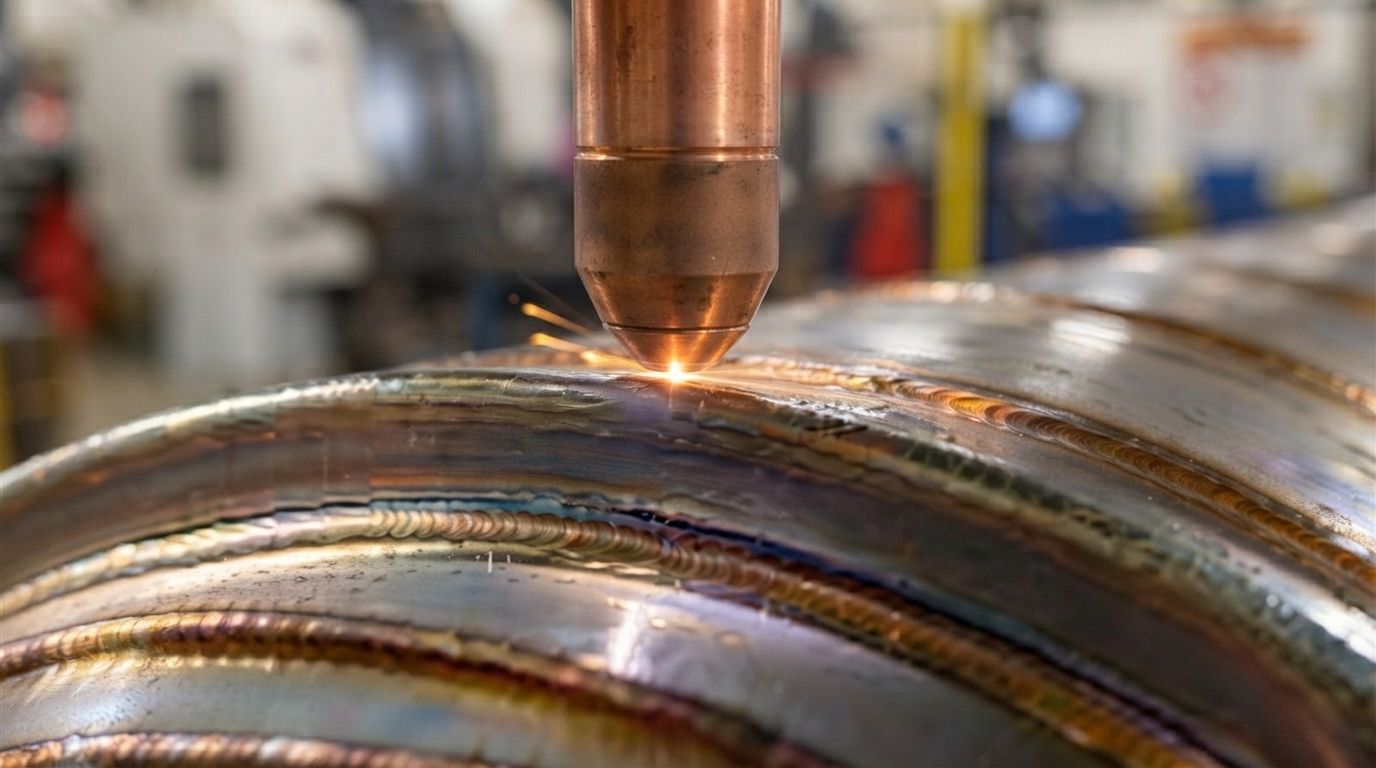
The structure of a Wire DED system can vary depending on the technology and energy source used, but most systems include several main components.
- Wire Feeding System
This component is responsible for transferring the metal wire to the deposition area at a specified and controlled rate.
The feed rate must be coordinated with other process parameters, as changes in it can affect the amount of deposited material and melting conditions.
- Energy Source
The energy source is responsible for providing the conditions required to melt the wire.
The type of energy source depends on the machine architecture. Some systems use lasers, others use electric arcs, and some equipment uses electron beams.
- Deposition Head
The head controls the point at which the wire and energy reach the build area.
The design of the head and its positioning relative to the part can affect process quality and the ability to create different deposition paths.
- Motion System
To build the part, the head or the part itself must move along specified paths.
This movement can be performed using a multi-axis system, allowing the machine to execute different paths on the part.
For projects involving complex parts or non-flat surfaces, the machine's motion capabilities become more important.
- Control System
The machine controller is responsible for coordinating movement, wire feeding, and other process parameters.
The more complex the process, the more important precise parameter control becomes.
- Build Platform and Holding Equipment
The part or substrate must remain securely positioned throughout the process.
For some projects, special fixtures are used to prevent the part from moving during the build.
Types of Wire DED Technology
Wire DED can be implemented using different methods based on the energy source used. The three main groups include laser-based, arc-based, and electron-beam systems.
1- Laser Wire DED
In Laser Wire DED, the laser provides the energy required to melt the metal wire.
The laser beam is focused on a specific location on the part, while the wire is simultaneously fed into the same area.
This method provides suitable control over the melt pool and can be used in projects where process control and path accuracy are important.
2- Arc Wire DED
In electric arc-based methods, the energy required to melt the wire is generated through an arc.
One of the well-known technologies in this group is WAAM or Wire Arc Additive Manufacturing.
This method has attracted attention in metal additive manufacturing projects due to its suitable deposition rate and ability to manufacture large structures and parts.
3- Electron Beam Wire DED
In this method, an electron beam is used to generate energy and melt the wire.
Electron-beam-based processes generally require controlled environmental conditions and specialized equipment, and their structure differs from laser- and arc-based systems.
What Metals Are Used in Wire Metal 3D Printers?
The type of metal that can be used in Wire DED depends on the machine, energy source, feeding system, and process conditions.
Since the feedstock in this technology is in the form of wire, suitable parts must be selected so that the material can be supplied in wire form and is also compatible with the equipment and process parameters.
For using a metal 3D printer in different applications, materials such as stainless steels, alloy steels, nickel alloys, titanium, and some aluminum alloys can be used.
However, the availability of an alloy in wire form does not mean that every wire metal 3D printer can process it with the same quality.
When selecting the material, factors such as alloy composition, wire diameter, melting behavior, thermal conditions, and the required properties of the part should be evaluated.
Why Does Wire Type Matter?
In Wire DED, the wire is not simply a consumable material. The feed rate, wire diameter, and metallurgical properties can affect how the layers are formed.
For example, if the wire feed rate is not synchronized with the system's travel speed, the amount of material deposited along each path will change.
Therefore, wire selection should be made alongside the selection of the machine and manufacturing process.
Applications of Wire Metal 3D Printers
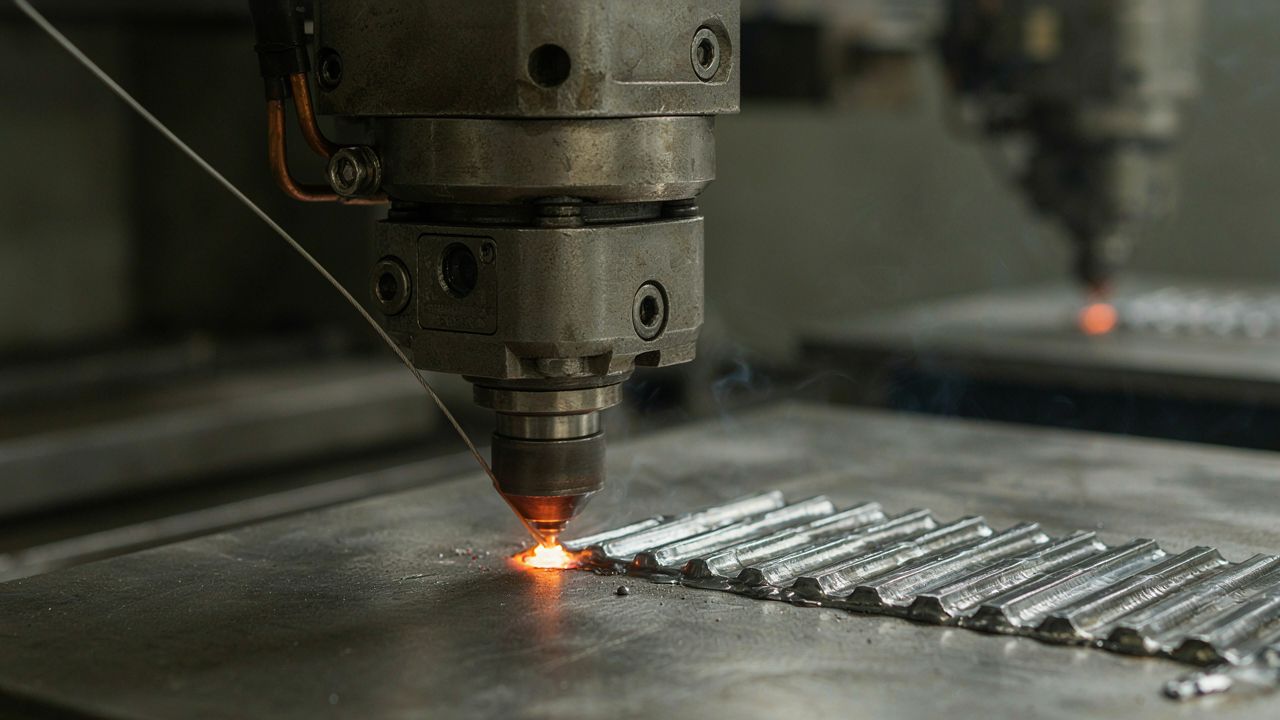
Wire DED can be considered for a wide range of industrial projects due to its material feeding method and its ability to create relatively large volumes during the manufacturing process.
Manufacturing Large Metal Parts
One of the important applications of this technology is manufacturing parts whose dimensions can be limiting for some other processes.
In this case, the machine can directly deposit material along specified paths and gradually create the volume of the part.
For example, manufacturing a large metal part with a relatively simple geometry over much of its volume can be one of the projects in which Wire DED is considered.
Manufacturing Near-Net-Shape Parts
In some projects, the part does not need to be manufactured with all of its final details from the beginning.
The main volume of the part can be created through additive manufacturing, and then areas requiring higher accuracy can be machined to achieve the final dimensions.
This approach can combine additive manufacturing and machining processes within a single production route.
Manufacturing Custom Parts
When the required quantity of parts is limited or the part has a custom-designed geometry, additive manufacturing processes can be considered.
For example, an industrial organization may require a part that is not readily available on the market. In such cases, the possibility of manufacturing it using Wire DED can be evaluated based on the material, size, and geometry of the part.
Repair and Restoration of Parts
Another application is repair and restoration of metal parts.
If a specific section of a part has lost some of its volume due to wear or damage, material can be added to that area when conditions are suitable.
For example, if the diameter of a section of an industrial shaft has decreased due to wear, the possibility of adding material and then machining the restored area can be evaluated.
In such projects, the goal is not to manufacture the entire shaft again; instead, the focus is on restoring the damaged section to the required dimensions.
Applications of Wire DED in Different Industries
The ability to use metal wire as feedstock and perform controlled material deposition has made Wire DED a technology of interest for various industrial projects.
- Oil, Gas, and Petrochemical
Equipment used in these industries may involve large components and demanding operating conditions.
In some oil, gas, and petrochemical projects, Wire DED can be used to manufacture or restore metal parts; however, the method should be selected based on the material of the part, operating conditions, and project requirements.
- Steel and Mining
In the steel and mining industries, many types of equipment are manufactured in large dimensions, and some of their components are exposed to continuous wear.
For this reason, additive manufacturing technologies capable of producing or adding a significant volume of material can be considered for some projects in this field.
- Power Plants
Power plant components may be affected over time by temperature, pressure, wear, and other operating factors.
In some projects, using metal 3D printers for power plant components, remanufacturing, or restoring a part may be considered, and Wire DED is one of the technologies whose feasibility should be evaluated based on the specifications of the part.
- Aerospace
In aerospace industries, the weight, mechanical properties, and quality of components are highly important.
Metal additive manufacturing has attracted attention in this industry for producing and developing various components. However, using Wire DED in such applications requires precise process control and compliance with the quality requirements of the part.
What Are the Advantages of Wire Metal 3D Printers?
One of the key features of Wire DED is the use of metal wire as feedstock. This enables continuous material feeding and can be an advantage for certain industrial processes.
The ability to manufacture large parts is another feature that has attracted attention to DED in large-scale projects.
On the other hand, this technology does not have to be used only for manufacturing new parts and can also be considered for projects that require material addition or restoration of a specific section.
The ability to combine additive manufacturing with machining is also an important advantage in industrial processes. In this approach, material can be deposited to create the main volume of the part, followed by machining of the required sections.
As a result, Wire DED can be part of a production chain rather than necessarily being the only process used to manufacture a part.
Limitations of Wire DED Technology
Despite the capabilities of this technology, it is not suitable for every type of part.
One important consideration is process accuracy and resolution. Wire DED is generally considered for applications where build volume and part size are important, and it may have limitations when creating very fine details.
On the other hand, the surface of the part after deposition does not necessarily reach the required final surface quality. Therefore, finishing operations such as machining are necessary or worth considering in many projects.
Thermal control is also important. Heat accumulation during the build can affect the shape of the layers and the properties of the part.
The final quality also does not depend solely on the machine itself. The wire type, process parameters, toolpath, and build conditions all play a role in the final result.
Difference Between Wire DED and Powder-Based DED
In both methods, the main goal is to add material in a controlled manner using an energy source, but the feedstock is different.
In Wire DED, the material enters the process in the form of wire, while powder-based DED uses metal powder.
This difference affects the way material is transferred, the design of the feeding system, and certain process characteristics.
Choosing between these two methods is a separate topic and should be based on factors such as part type, material, accuracy, build volume, and application. A detailed comparison of Wire DED and powder-based DED can be covered in a separate article.
What Factors Are Important When Choosing Wire DED?
If you are planning to select a Wire DED machine for your industrial project, it is better to start with the part itself rather than the machine's advertised specifications.
First, you should determine the dimensions of the part and the amount of material that needs to be deposited during the process. This information can help determine the required working volume and machine capacity.
Material type is also highly important. You should determine which alloys the machine supports and which types and diameters of wire are compatible with its feeding system.
The energy source is another key factor. The choice of a laser, arc, or electron-beam system should be based on the process requirements and the type of part.
Motion accuracy, the number of axes, and the system's movement capabilities are also more important in projects involving complex geometries.
In addition to these factors, it is better to evaluate process control and monitoring capabilities, software, post-processing options, and technical support services.
A More Important Criterion Than the Numbers in the Catalog
Suppose two machines have similar figures in terms of build volume and deposition rate. This alone does not indicate that both machines are suitable for your project.
If the material you need is not supported by one of the machines, or if the geometry of the part is not compatible with its motion range, the machine's other specifications cannot solve this problem.
Therefore, the best starting point for choosing a wire metal 3D printer is to determine your actual production requirements and then match them with the capabilities of the machine.
For Which Projects Can It Be Considered?
To answer this question, several project characteristics should be considered at the same time.
If you are dealing with a large, metal, and relatively high-volume part, Wire DED can be one of the options worth considering.
If the project requires adding material to an existing part or restoring a specific section, this technology can also be evaluated.
Likewise, for manufacturing custom parts or projects that require creating an initial volume followed by precision machining, Wire DED can be part of the manufacturing process.
However, if the part is very small and fine details and high accuracy are the top priorities, other additive manufacturing technologies should also be considered alongside Wire DED.
Ultimately, the technology should be selected based on geometry, material, dimensions, production volume, required accuracy, and part application.
Choosing a Wire Metal 3D Printer at Vandad Sanat
When it comes to selecting industrial equipment, having the same technology name does not mean that all machines have the same capabilities for a given project.
At Vandad Sanat, additive metal manufacturing equipment can be evaluated based on production requirements; in other words, the first step is to determine what part needs to be manufactured, what material is required, and what dimensions and quality need to be achieved.
Vandad Sanat metal 3D printer are designed for industrial applications, and the specifications of each machine can be evaluated for different projects.
If you are in the process of selecting a machine, reviewing technical specifications, build volume, process capabilities, and application type is important before making a decision. Information about the equipment is provided on the product page so that you can compare the machine's capabilities with your project requirements.
For more information about the equipment, you can contact Vandad Sanat experts and explore the machine that best suits your production requirements:
- Phone number: 09102017107
Conclusion
Wire metal 3D printer is one of the metal additive manufacturing technologies in which metal wire is used as the feedstock.
In Wire DED technology, the wire and energy source work together to melt and deposit material along specified paths. By repeating this process, new layers are created and the part gradually takes shape.
This technology can be used for manufacturing large parts, producing custom components, creating an initial volume for machining, and, in some projects, repairing and restoring parts.
However, the selection of Wire DED should be based on the actual requirements of the project. Wire material and diameter, energy source, part dimensions, geometry, accuracy, deposition rate, and post-processing operations all play a role in selecting the appropriate technology and machine.
Therefore, if you are considering using a wire metal 3D printer, it is better to first determine the specifications of the part and the required process, and then match them with the capabilities of the machine.
Frequently Asked Questions
1- What material does Wire DED use?
The feedstock in Wire DED is in the form of metal wire. The alloy type and wire diameter must be compatible with the machine, feeding system, and process conditions.
2- What parts is Wire DED suitable for?
This technology can be particularly considered for certain large parts, custom manufacturing projects, and applications that require material addition or metal additive manufacturing.
3- Can a wire metal 3D printer be used to repair parts?
In some cases, yes. If the damage is limited to a specific area, the possibility of adding material to that section and then machining the restored area can be evaluated.
4- Does a part manufactured with Wire DED require machining?
In many projects, finishing operations such as machining are required to achieve the final dimensions, tolerances, and surface quality.
5- What energy sources can Wire DED use?
Depending on the system, Wire DED can be implemented using different energy sources such as lasers, electric arcs, and electron beams.
6- Is Wire DED suitable for large parts?
DED is generally considered for applications involving large parts and high build volumes. However, its suitability for a specific part depends on its dimensions, geometry, material, and project requirements.
7- What should be considered when purchasing a wire metal 3D printer?
The energy source, compatible materials, wire diameter, build volume, motion accuracy, deposition rate, control system, monitoring capabilities, post-processing options, and technical support services are among the factors that should be evaluated.
نظرات
0 نظر
دیدگاهی ثبت نشده.